
'Building on the potential for closer ties is the changing narrative in each country about the other. The Chinese narrative on India has become significantly more positive over the past few years,' says Walter Andersen and Zhong Zhenming.
'This country has become cynical, the country has lost hope. Prime Minister Narendra Modi is getting back hope in this country.' 'We are deconstructing the past which had corruption, inefficiency, policy paralysis, a tottering economy where investors had lost confidence, and people had become cynical. We are changing that, we are bringing confidence back to the people of India.'

'India needs to adopt a more proactive policy of triggering exports to China.'

The differently-abled deserve a normal life. Nothing will stop Poonam Natarajan from ensuring that India, slowly but surely, gives it to them, discovers Shobha Warrier.

As India rises, creating niche areas for itself in the Asian landscape, China and India are bound to step on each other's vital areas of importance, says Srikanth Kondapalli.

Clearly, LoCs are becoming a key arrow in India's economic diplomacy quiver.

The elements are all aligned to make India a global powerhouse, says IMF Managing Director Christine Lagarde.

One of Indian TV's most famous faces tells Kanika Datta why and how she hopes to reinvent herself in the uncharted territories of multimedia and think tanks

Friends and colleagues pay rich tributes to the "charming, approachable, and very accessible" Indian Constitution scholar Granville 'Red' Austin.

'The sadhus and sanyasis of UP are not for any economics.' 'They only know the religious agenda and the RSS will support them.' 'Modi does not have full control of the party at the ground level like Indira Gandhi had.'

Although the markets could see a knee-jerk reaction, they rule out a sharp fall.
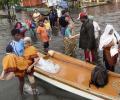
Why did Chennai go under in the recent rains? R Ramasubramanian paints a familiar picture of dismal urban town planning, civic short-sightedness, and rampant development that caused the recent nightmare.

Bengaluru dominates Karnataka's economy and its infrastructure mess compounds the problems, with policies lagging need and expectations.

Performance counts more than populist slogans when you are in power, says N Sathiya Moorthy.
'I have seen in action six prime ministers and ten chief ministers, considered stalwarts in their days, and it is the first time, in all my experience, that a prime minister has gone into such great detail, laying down even the standards of cleanliness that should be maintained in all offices,' says B S Raghavan, former chief secretary, West Bengal.

'The default by the State or its agents in terms of deprivation, exclusion and discrimination (including failure to provide security) is to be corrected by the State; this needs to be done at the earliest and appropriate instruments developed for it.'
'I am aware that mention of a threat to Gulmarg emanating from my perception may send negative signals to tourists but there are realities which need to be taken stock of.' 'Gulmarg is not far from Srinagar and is what the army calls in its parlance "a big name place." Such places draw attention much faster when negative incidents take place and give value of eyeball attraction.'

Prime Minister Narendra Modi had gone to China with a bagful of initiatives, but not all seems to have been fulfilled given China's reluctance to go the whole hog with him
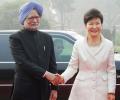
South Korean President Park Geun-hye's visit to India will enhance economic and military ties between the two countries and give the relationship a strategic dimension, says Jiye Kim.

'After more than 20 years of understanding, nothing much seems to have been achieved. What the two countries have been trying to do is to manage the recurrence of border incursions. The two sides must address the disease, and not the symptom of the disease,' says Rup Narayan Das.

The failure to restructure our armed forces in line with contemporary needs 14 years after the Kargil war will impose strategic costs beyond just delays and scandals, says Nitin Pai

Dr Raghuram Rajan's departure holds lessons for all, be it sections of the media, politicians or the people themselves. We need to learn how to value and retain talent. At the same time the talented must realise that talent alone does not ensure the top job, says Sanjeev Nayyar.

Upon implementation of the 7th Pay Commission the expected yearly burden on the central exchequer will be more than Rs 100,000 crore. Central government employees will get on an average a 24 per cent pay hike. Still, the unions aren't happy.

Saundarya Rajesh has helped more than 8,000 women get back to work.

Though Muslims have been trusted allies of Jats since the days of former Prime Minister Charan Singh, experts feel the alliance has had its share of strains following his death in 1987

If the drop in sales over the past two years is anything to go by, India's dream of putting seven million electric vehicles on road by the end of this decade has come a cropper.

Nisha Agarwal, commissioner of the New York Mayor's Office of Immigrant Affairs, recalls, with both anguish and elation, the events of the last fortnight after the US President's order banning entry for people from seven countries was put in place.

'We have a common way of looking at the world, a common way of thinking, and a common set of values that predispose us to be partners. And our interests overlap greatly,' Dr Ashton B Carter, America's next defence secretary, told Aziz Haniffa/Rediff.com in an exclusive interview.

Four major political takeaways from Narendra Modi's much-anticipated trip to China

'If the Americans believed that India is as strong as China or Russia, would they have shown this scant respect for us,' asks Tarun Vijay, MP. 'An economically strong and militarily powerful India would never have had this experience. Not just the Americans, everyone in this world respects might. China receives respect, India gets the law book.'

But he is actively pursuing greenfield steel plants in Karnataka and Jharkhand; ultimately, only one of these might come up.
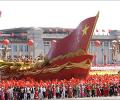
Premier Li Keqiang highlighted his government's performance in the last one year and the challenges ahead in various fields. Compared to other reports by his predecessors, Li spoke more frankly about the mounting challenges faced by the country. Srikanth Kondapalli on the two recent Chinese parliament sessions.

'She was the only prime minister who won a decisive military victory.' 'She won a real war; she didn't play video games on prime time TV over surgical strikes!' 'She understood power better than any other politician, saw it as her birthright and used it with inborn expertise.' 'Every politician today who tries to be a "supremo" through populism and absolute control over his or her party is referring to the Indira Gandhi playbook!'

'The BJP said they want less government and more governance. But they are doing neither. It is shocking to see them so ineffective.'
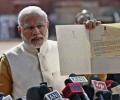
he has to demonstrate the ability of his government to take a quantum leap, almost tantamount to setting the Ganga on fire, in the next six months, if not in 100 days, if the people were to take seriously the cascade of commitments spewing out of the President's address to both Houses of Parliament on June 9, says B S Raghavan. B S Raghavan suggests five practical propositions through which the Modi government can bring in paradigm changes.

'When workers in other industries enjoy protection, why should sex workers not receive similar protection?' 'Sex work should be treated as work and brought under the work schedule of the labour department.' 'We will only end up giving immunity to the pimps and brothels to buy or sell human beings. This will in turn increase trafficking of young women and children.' Rashme Sehgal reports on the debate over legalising prostitution, a bugle in whose favour has been sounded by the new chairperson of the National Commission for Women, Lalitha Kumaramangalam.

'The BJP has latched on to the idea of nationalism, but the nationalism they advocate is not nationalism as we have understood it since the time of the freedom movement.' 'This is not secular nationalism, it is Hindu nationalism.' 'It is a form of nationalism that is exclusionary and it tends to conflate national interest with the government.' 'So, if you disagree with the government, for example, on surgical strikes or demonetisation, you are anti-national or holder of black money.'

'I am no longer surprised by how cynical university students generally are about American motives. America, no matter who the President, what the circumstances will act like a bully, is their collective belief,' says Ambassador B S Prakash after a recent interaction with students.

In the second and concluding part of his interview, Gurumurthy outlines the two areas he believes the government should focus on.

India has built two top-secret facilities in Karnataka to enrich uranium in pursuit of its hydrogen bomb dream.
